
Travel in 2026 is not short of options. It is short of clarity. The flight map has been redrawn by geopolitics, the cost of getting somewhere no longer tracks with the cost of being there, and the destinations that dominated last decade’s bucket lists are, in many cases, struggling under the weight of their own popularity. The traveller who moves thoughtfully this year, who chooses with intention rather than habit, will have some of the best trips of their life.
This is Nomadical Tracks’ definitive guide to the best places to travel in 2026. Incredible destinations, ordered by momentum and opportunity, written for the traveller who wants more than a highlight reel. Where to go, what it actually delivers, and why 2026 specifically is the right moment to go there.
Table of Contents
1. Vietnam
Few countries on earth ask so little of you and return so much.
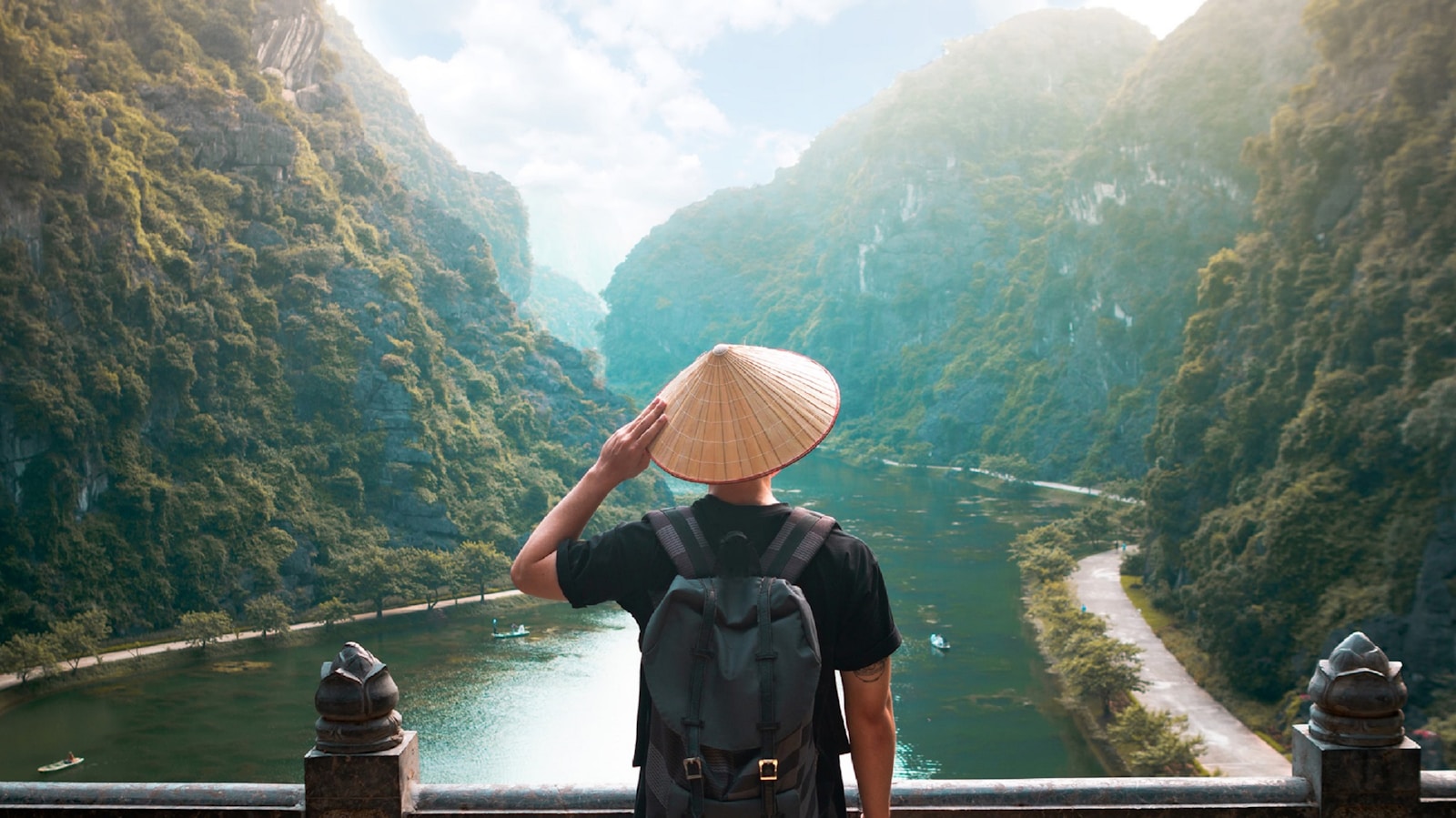
There is a moment, somewhere between your first bowl of bún bò Huế and your third morning waking up to the bustle of Tam Coc, when Vietnam stops being a destination and becomes a reference point — the trip everything else gets measured against. It is a country of extraordinary regional specificity, where the food, the architecture, the pace and the light change so completely between north and south that a single visit never feels like enough. That is not a flaw. It is the design.
The classic Vietnamese journey — Hà Nội to Hội An to Hồ Chí Minh City — works because each city is doing something entirely different. Hà Nội is dense, fast and unapologetically itself: a city of lakes and labyrinthine streets that has absorbed a thousand years of history without smoothing its edges for visitors. The Old Quarter is genuinely chaotic in ways that reward patience and punish rushing. The street food here, bánh cuốn at dawn, phở from a cart that has occupied the same pavement for forty years, is some of the most regionally distinct cooking in Southeast Asia. This is not the Vietnam of tourist menus.
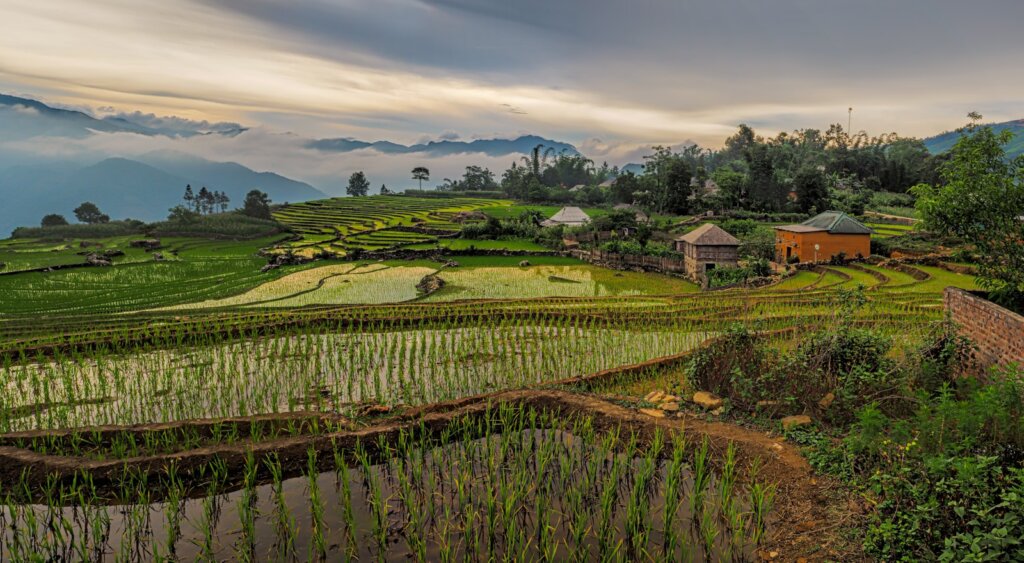
Hội An is the counterweight. A UNESCO-listed trading port of lantern-lit lanes and restored merchant houses, it operates at a pace that invites you to slow down rather than move through. The town has developed a legitimate wellness infrastructure around that slowness — boutique spa retreats, cooking schools built into family homes, cycling routes through rice paddies that take you far enough out to feel like you’ve disappeared. For the traveller seeking soft adventure, the Marble Mountains and the limestone karsts of the surrounding coast offer half-day escapes that never feel packaged. For golfers, the Da Nang corridor has quietly become one of Southeast Asia’s most compelling circuits: Montgomerie Links, BRG Da Nang Golf Resort and the Greg Norman-designed Danang Golf Club sit within minutes of each other, with the Hoiana Shores course by Robert Trent Jones Jr. a short drive south. These are not resort courses filling a gap in the itinerary. They are genuinely worth building a trip around.
Hồ Chí Minh City closes the journey with a different energy entirely, kinetic, ambitious, layered with French colonial architecture and a food culture so dense and specific that first-time visitors typically arrive thinking they understand Vietnamese cuisine and leave realising they have only just started. The rooftop bars of District 1, the market kitchens of Bình Tây, the war history that sits quietly alongside boutique hotels and tasting menus — HCMC rewards the traveller who engages rather than observes.
And then there is the beach question. Vietnam’s coastline is long and genuinely varied. Phú Quốc, a near-tropical island off the southern tip, is seeing flight searches from the UK up 184% year-on-year for good reason: white sand, clear water and an evolving luxury hotel scene that still trades at Southeast Asian prices. Skyscanner named it the second most globally trending destination for 2026. The less-told story is further north: Quy Nhơn, which Lonely Planet included in its Best in Travel 2026 list, is the kind of fishing town that feels discovered but not yet crowded, Cham tower ruins, empty beaches and some of the most direct seafood cooking in the country.
Vietnam Airlines operates the only direct UK service, flying from Heathrow to Hà Nội in around 11 hours 45 minutes and to Hồ Chí Minh City in 12 hours 40 minutes. UK passport holders enter without a visa for up to 45 days. Hội An has no airport, fly into Đà Nẵng, 30km north, and the transfer is straightforward. The pound buys roughly 35,500 dong (April 2026), which in practice means the gap between what a trip costs and what it delivers is wider here than almost anywhere else on this list, not because Vietnam is just “cheap destination”, but because it is extraordinarily generous with what it offers.
Nomadical Tracks has travelled Vietnam extensively. See our on-the-ground content — including restaurant reviews from Hội An — over on our YouTube Channel.
2. Morocco
The Sahara is four hours from Heathrow. That fact alone should stop you in your tracks.
Morocco does something no other short-haul destination quite manages: it delivers genuine scale. Not the manicured scale of a European city break, or the manufactured scale of a resort. Real scale — the kind where you stand at the edge of an erg at dusk, the dunes running to the horizon in every direction, the silence so complete it becomes a physical presence, and you feel, correctly, that you are somewhere that has nothing to do with the world you left behind forty-eight hours ago. That is Merzouga. That is the Sahara. And it is closer to London than Reykjavik.
But Morocco is not one thing, and that is the point. It is a country that contains multitudes — imperial cities of dizzying complexity, Atlas mountain valleys where lunch is served beside a river and the only sound is water, desert kasbahs that have appeared in more films than their inhabitants could name, golf courses with the Atlas as a backdrop, riads in Marrakech where the architecture alone justifies the flight. The traveller who does Morocco well does not do one of these things. They do several, connected by a country that rewards movement.
Fès is where you understand what Morocco actually is. The medina — a UNESCO World Heritage Site and the world’s largest car-free urban area — is a living medieval city that has been in continuous operation since the 9th century. The souks are organised by trade in the traditional manner: dyers here, tanners there, metalworkers in the next quarter, the smell and sound shifting with every alley. The Chouara Tannery, viewed from the leather shops that ring its upper floors, is one of those genuinely arresting urban images that photographs cannot prepare you for. Fès is not always comfortable. It is not designed for browsing. It demands engagement, and it rewards it with a depth that Marrakech, for all its seductions, cannot match.
Marrakech is the gateway for most UK travellers and earns its popularity, provided you engage with it on the right terms. The Djemaa el-Fna — the great square at the heart of the medina — is theatre from late afternoon onwards: food stalls that materialise at dusk, smoke rising from a hundred grills, storytellers and musicians performing to crowds that have gathered in this same square for centuries. The food scene around it ranges from the spectacular to the tourist-trap, and the difference is usually one side street away. Beyond the square, Marrakech has developed a luxury riad culture that is genuinely world-class: restored 16th-century courtyard houses with plunge pools and rooftop terraces, where the design is the experience as much as the city outside. La Mamounia remains the benchmark — one of the great hotels of the world in a garden that Winston Churchill painted on multiple visits. El Fenn, Riad Yasmine, Dar Ahlam in Skoura — the list of exceptional small properties in and around the city is long and getting longer ahead of the 2030 World Cup investment surge.
The golf around Marrakech deserves its own conversation. The Palmeraie circuit — Royal Golf Dar Es Salam, Amelkis, Samanah Golf & Country Club — offers courses of genuine quality set against the High Atlas, at a fraction of the green fee you would pay in Spain or Portugal. The combination of reliable winter sunshine, short flight from multiple UK airports and competitive pricing makes this one of the most compelling short-haul golf propositions in Europe or North Africa. The season runs October through April, which aligns conveniently with the period when UK golfers most need to leave.
From Marrakech, the road south into the Atlas Mountains is one of the great drives in Africa. The Tizi n’Tichka pass, reaching 2,260 metres through switchbacks and Berber villages, is the approach route to the south — and the journey itself is the point as much as the destination. Stop at a roadside restaurant above a river valley for a lemon chicken tagine slow-cooked in a clay pot, eaten on a terrace with a view of terraced hillsides and walnut trees, and you will understand why Moroccan cuisine has earned its reputation. This is not restaurant food or tourist food. It is home food, produced with a confidence and specificity that comes from centuries of refinement. The preserved lemon, the argan oil, the spice combinations that somehow taste of both desert and mountain — it is a cuisine that rewards curiosity at every level, from street stalls to the tasting menus at Nomad in Marrakech.
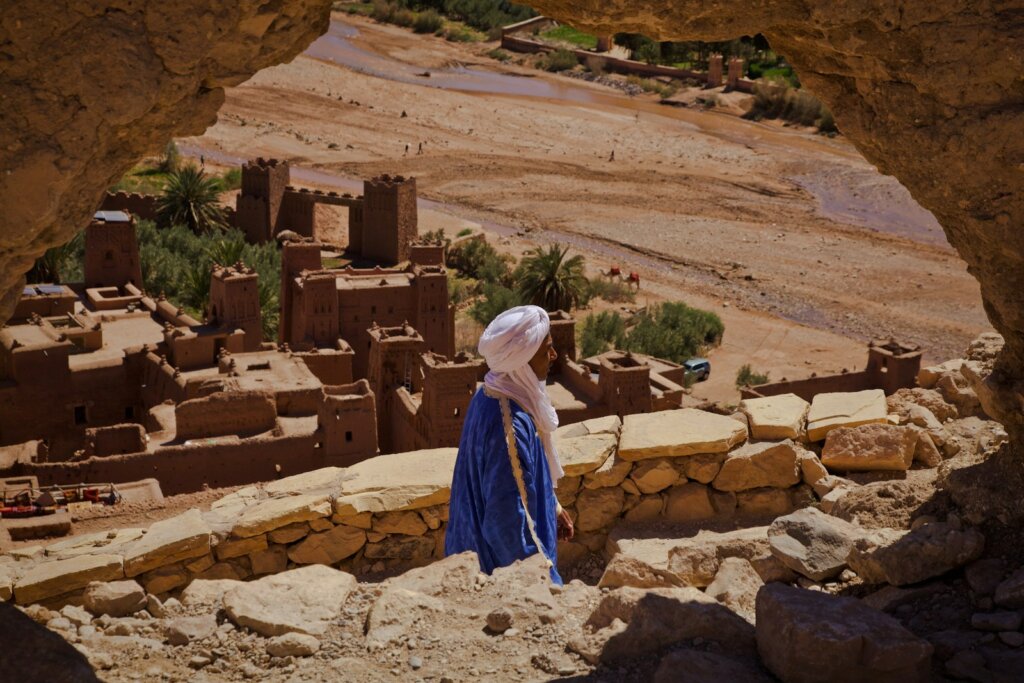
Aït Benhaddou sits about an hour west of Ouarzazate and is the single most cinematically striking site in Morocco — a fortified ksar of earthen buildings rising from the valley floor, with the Ounila River running at its feet and the Saharan foothills behind. Gladiator, Lawrence of Arabia, The Mummy, Game of Thrones — the list of productions shot here is a useful shorthand for the scale and drama of the landscape. But Aït Benhaddou in person is more affecting than any of those films suggest: a UNESCO World Heritage Site that is still partly inhabited, its towers and granaries and communal spaces telling a story of Saharan trade routes that pre-dates Islam. The combination of Aït Benhaddou and the drive on to Merzouga — through the Draa Valley, past kasbahs and date palms and a landscape that gradually empties of everything except light and rock — is a full-day journey that delivers more sustained visual drama than almost any road trip you could name.
Merzouga is the base for Erg Chebbi, a sea of dunes that rises to 150 metres and stretches roughly 28 kilometres. The mechanics are straightforward — a camel trek or 4×4 to a desert camp as the sun drops, dinner under a sky with no light competition for forty miles in any direction, a night in a Berber tent or, if the budget extends, a luxury camp with private terraces and a telescope. The execution matters less than the setting: sleeping in the Sahara is one of those experiences that resolves a question you didn’t know you were asking. The best window is October to April, when daytime temperatures are manageable and nights are cold and clear.
For the walker, Mount Toubkal — the highest peak in North Africa at 4,167 metres — is a serious objective that is also, with the right guide and preparation, achievable for fit travellers without technical climbing experience. The standard two-day ascent from the Imlil valley involves a night at the Toubkal Refuge at 3,207 metres and a pre-dawn summit push. The views from the top, across the Atlas and south towards the Sahara, are proportionate to the effort. The approach through the Imlil valley — Berber villages, terraced fields, mule tracks — is beautiful enough to justify the trip even if the summit doesn’t happen.
Morocco is visa-free for UK passport holders, a three-hour forty-minute flight from London on British Airways, easyJet, Ryanair and a half-dozen others, and the pound currently buys around 12.45 dirhams. It is hosting, alongside Spain and Portugal, the 2030 FIFA World Cup — which means infrastructure investment on a scale that will transform the country’s transport network over the next four years. Travel now, before it does.
3. South Africa
South Africa compresses more world-class experience into a single trip than almost any destination on earth.
A morning watching a leopard move through the bush at Sabi Sands. A two-hour drive to a Stellenbosch wine estate for a long lunch on a terrace with Table Mountain in the distance. Dinner back in Cape Town at one of the best restaurants in the southern hemisphere. That is not an exceptional day in South Africa. That is a fairly standard one — and it is the reason travellers who come once tend to return with a longer list.
The exchange rate deserves a brief acknowledgement, not because this is a budget travel piece but because it reframes what South Africa actually is for UK visitors. The pound buys around 22 rand. That means a night at a private game lodge that would cost the equivalent of a four-star London hotel puts you in a luxury property with a private plunge pool, two game drives daily and a chef cooking by firelight. The value is not the point — the experience is — but the two happen to align here in a way that is rare at this level of travel.
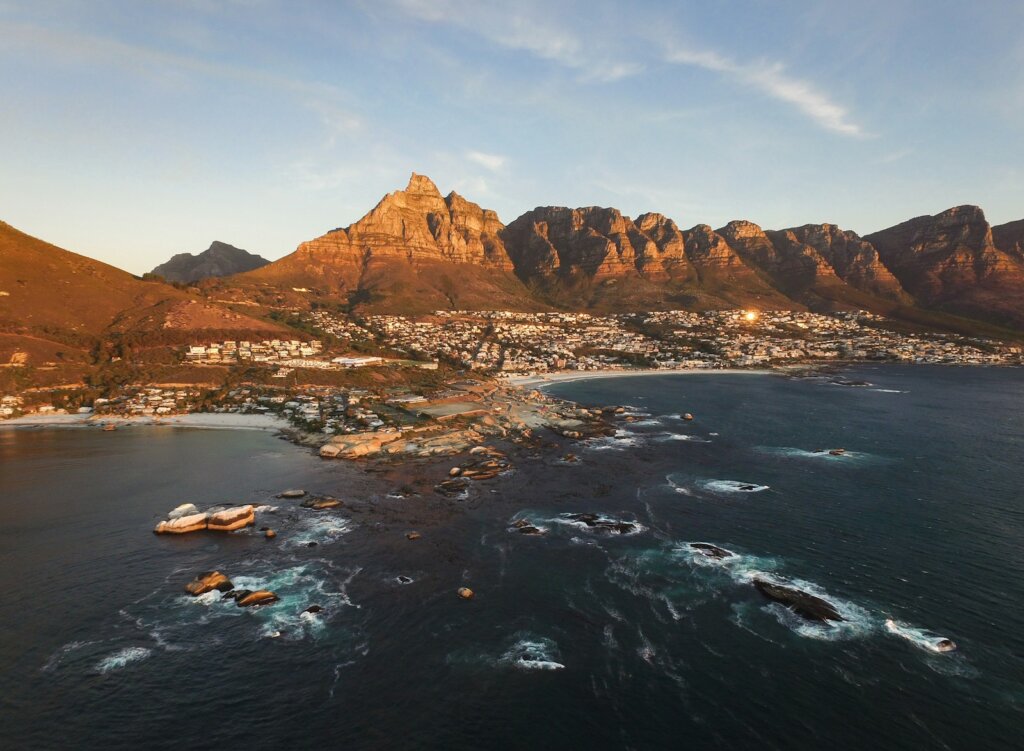
Cape Town is the anchor, and it earns the position. A food scene that runs from harbour fish markets to restaurants with genuine creative ambition. A design culture that has produced some of the most interesting small hotels in Africa. A mountain you can be on top of within twenty minutes of the city centre. Table Mountain — hiked via Platteklip Gorge or Skeleton Gorge, or reached by cable car — frames every view of the city and dominates every morning from a balcony above the Atlantic. The Bo-Kaap neighbourhood, with its painted houses and Cape Malay cooking; Woodstock’s gallery district; the long cold-water beaches at Camps Bay and Clifton. Cape Town rewards the traveller who moves beyond the obvious circuit, and it keeps rewarding them.
The Winelands begin less than an hour east, and the route through Stellenbosch, Franschhoek and Paarl is one of the most rewarding single days you can spend in South Africa. Franschhoek in particular has built its identity entirely around the table — La Motte, Leeu Estates, The Tasting Room at Le Quartier Français among the properties that have put South African wine and food firmly in the international conversation. The Chenin Blancs, the Pinotage, the Bordeaux-style blends from the Helderberg — wines made at a level that benchmarks against the best in the world, priced at a fraction of European equivalents. This is not a wine region you visit out of curiosity. It is one you visit and immediately start planning to return to.
The Garden Route is the natural next move — a 300-kilometre stretch of coastline between Mossel Bay and Storms River that suits the road-trip format perfectly. Knysna, built around a lagoon ringed by forest, is the largest base. Plettenberg Bay offers world-class whale watching between August and November. Tsitsikamma National Park, at the eastern end, is wilder and more dramatic — the Storms River Mouth suspension bridge and the five-day Otter Trail are the headline draws, but the ancient coastal forest makes a case for simply walking without a fixed plan.
At Gansbaai, two hours east of Cape Town, great white sharks aggregate in the channel between Dyer Island and Geyser Rock — a stretch of water known as Shark Alley. Cage diving here is not the manufactured version of the experience. The sharks are large, the water is cold and green, and the encounter is genuinely arresting in a way that photographs afterwards never quite capture.
For surfers, Jeffreys Bay sits just beyond the Garden Route’s eastern end and requires no qualification. Supertubes is one of the fastest right-hand point breaks in the world — a wave that even experienced surfers spend days trying to read. The town around it is small and purposeful. There is no particular reason to be there except the wave, which turns out to be reason enough.
Safari is a decision between volume and quality. Kruger National Park delivers on volume — two million hectares of Big Five country, well-maintained camps, a self-drive circuit that ranks among the great wildlife road trips. The private concessions on Kruger’s western border — Sabi Sands, Timbavati, Klaserie — operate at a different register. Off-road vehicles, guides whose knowledge of individual animals is biographical, and unfenced access to the same ecosystem. Sabi Sands — home to Singita, Londolozi and Mala Mala — has a density of leopard sightings unmatched anywhere on the continent. These are not the cheapest nights you will spend in Africa. They are among the most memorable.
Golf here operates on a different scale. Leopard Creek, adjacent to Kruger, plays alongside the Crocodile River with animals visible from the fairways. Fancourt in George — five courses, host of the President’s Cup — features in global top-100 rankings regularly. The climate, the exchange rate and the course quality make South Africa one of the most compelling golf destinations in the world at a price point European alternatives cannot approach.
A Springboks test match at Ellis Park or DHL Newlands belongs on any itinerary passing through during the rugby season — loud, physical, deeply felt in a way that most European sporting events are not. And Robben Island, a thirty-minute ferry from the V&A Waterfront with tours led by former political prisoners, is not the most comfortable afternoon in South Africa. It is one of the most important.
No visa required for UK passport holders. Cape Town is 11 hours 45 minutes direct from Heathrow. South Africa has now passed 328 consecutive days without load-shedding — the power crisis that defined its travel narrative for several years is, for now, a chapter rather than a current condition. The gap between perception and reality here is significant. That is the opportunity.
4. China
China is the most misunderstood travel opportunity of 2026 — and the window to go has just opened wider than it has in years.
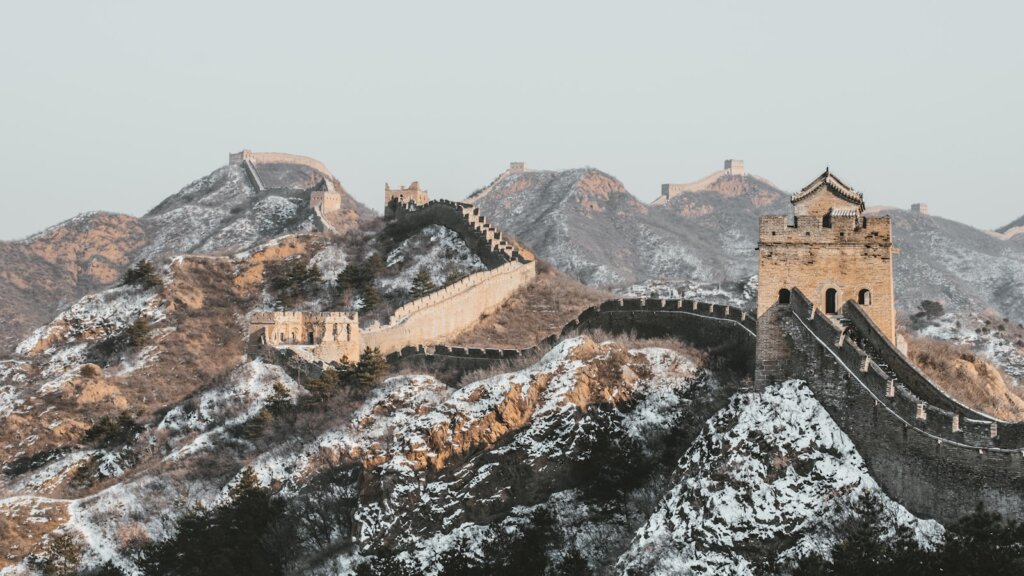
There is a perception gap around China that has widened in direct proportion to the geopolitical noise of the past decade. The country that exists in most Western travel conversations — remote, difficult, unwelcoming — bears little resemblance to the one you actually arrive in. China’s cities are among the most dynamic on earth. Its landscapes range from the surreal to the genuinely sublime. Its food culture is so regionally varied and technically sophisticated that a serious traveller could spend months working through a single province. And from 17 February 2026, UK passport holders can enter mainland China visa-free for up to 30 days — a diplomatic shift that removes the last significant practical barrier and makes 2026 the most accessible moment to visit in a generation.
The flight situation is worth understanding clearly, because it cuts against the prevailing narrative. While Russia’s airspace closure has added hours and cost to routes across the Middle East and Asia for Western carriers, Chinese airlines — Air China, China Southern, China Eastern — continue to overfly Russia, which means their London routes run 10 to 11 hours rather than the 12 to 14 hours that comparable long-haul flights now require. Air China operates daily from Heathrow to Beijing Daxing; China Eastern flies daily to Shanghai Pudong in around 11 hours. British Airways also operates the London–Shanghai route. The practical implication is that flying to China on a Chinese carrier in 2026 is faster and often cheaper than flying to several destinations that feel less ambitious.
Shanghai is where most itineraries begin, and the city earns its reputation as one of the great urban experiences on earth. The Bund — the colonial-era waterfront facing the Pudong skyline across the Huangpu River — delivers a juxtaposition of architectural eras that is uniquely Shanghainese: 1930s Art Deco banks and trading houses on one side, the 632-metre Shanghai Tower and the bottle-opener silhouette of the Shanghai World Financial Centre on the other. But Shanghai’s real texture is in its neighbourhoods. The former French Concession, with its plane-tree-lined streets and converted longtang houses turned into coffee shops and restaurants, is one of the most walkable urban environments in Asia. The food scene — from Shanghainese soup dumplings at Yang’s Fry-Dumpling to the tasting menus emerging from a new generation of chefs — reflects a city that takes eating with total seriousness.
Yunnan province, in China’s southwest, is the counterpoint to Shanghai’s urbanity — a landscape of extraordinary diversity that shifts from the subtropical river valleys of the south to the Tibetan plateau in the northwest within a single province. The classic circuit through Kunming, Dali, Lijiang and Shangri-La is now connected by high-speed rail, which transforms what was once a logistically demanding journey into a sequence of two-hour train rides through mountain scenery. Dali sits on the shores of Erhai Lake beneath the Cangshan range — a town of white-walled Bai architecture and easy pace that functions as a natural decompression point. Lijiang’s Old Town, a UNESCO World Heritage Site of Naxi wooden houses and cobbled waterways, is genuinely beautiful even through the tourist infrastructure that has grown around it. The journey north to Shangri-La — the last Han Chinese city before the Tibetan cultural zone takes over — culminates at Songzanlin Monastery, a 17th-century Tibetan Buddhist complex that sits above the town on a hill and commands a view across the plateau that stops conversation.
Xi’an is one of those cities that recalibrates your sense of historical scale. The ancient capital of thirteen Chinese dynasties, it was the eastern terminus of the Silk Road and the most cosmopolitan city on earth during the Tang Dynasty — a period when it held over a million inhabitants and welcomed merchants, monks and diplomats from Central Asia, Persia and beyond. The Terracotta Warriors, discovered by farmers digging a well in 1974 and still only partially excavated, are the obvious headline: an army of 8,000 individually rendered figures buried with Qin Shi Huang in 210 BC, arranged in battle formation in three vast pits. They are extraordinary in photographs and more extraordinary in person, where the scale of the project — and the centuries of earth that covered it — becomes fully legible. The city itself repays time beyond the warriors: the Muslim Quarter’s food street, the ancient city walls navigable by bicycle, the Great Mosque of Xi’an, which has operated continuously since 742 AD in a compound that looks more Chinese than Islamic and is quietly one of the most remarkable religious buildings in Asia.
Zhangjiajie in Hunan province is where China delivers something that exists nowhere else on earth. The sandstone pillars of the Zhangjiajie National Forest Park — rising vertically from the valley floor, draped in cloud and subtropical vegetation, reaching heights of over 200 metres — are the landscape that inspired the floating mountains of Avatar, and seeing them in person confirms that the film’s art department had very little work to do. The Zhangjiajie Glass Bridge, 430 metres long and suspended 300 metres above the canyon at the Grand Canyon scenic area, is either the best or worst idea you have ever encountered depending on your relationship with heights. The cable car to Tianmen Mountain — the longest passenger ropeway in the world — ascends through cloud to a cliff-face staircase cut directly into the rock face. Zhangjiajie is not subtle. It is also genuinely unlike anything else.
Two practical realities require honest acknowledgement. China’s Great Firewall remains fully intact — Google, WhatsApp, Instagram, YouTube and most Western news sites are inaccessible without a VPN. Install two reliable paid VPNs before you leave the UK; you cannot download them once you are behind the firewall. The second is payments: Alipay and WeChat Pay, China’s dominant payment platforms, now accept foreign Visa and Mastercard directly and can be set up before travel. Cash is increasingly irrelevant in Chinese cities. The digital infrastructure, once genuinely difficult for international visitors, has been substantially improved — but it requires preparation, not improvisation.
The 30-day visa-free access runs until 31 December 2026. UK tourism to China is up an estimated 24% year-on-year as awareness of the policy spreads. The travellers who move early on information advantages tend to have the better trips. This is one of those moments.
5. Canada
Canada suffers from a particular kind of underestimation — the assumption that a country this vast and this well-known must have already been fully understood.
It has not. Canada is the second-largest country on earth, and the version of it that most UK travellers carry around — Niagara Falls, a Banff postcard, possibly a weekend in Toronto — represents a fraction of one percent of what it actually contains. The Rocky Mountain corridor is as spectacular as its reputation suggests, and it is worth every superlative that has ever been written about it. But Canada’s greatest travel stories are not all in the same place, and some of the best ones are barely told at all.
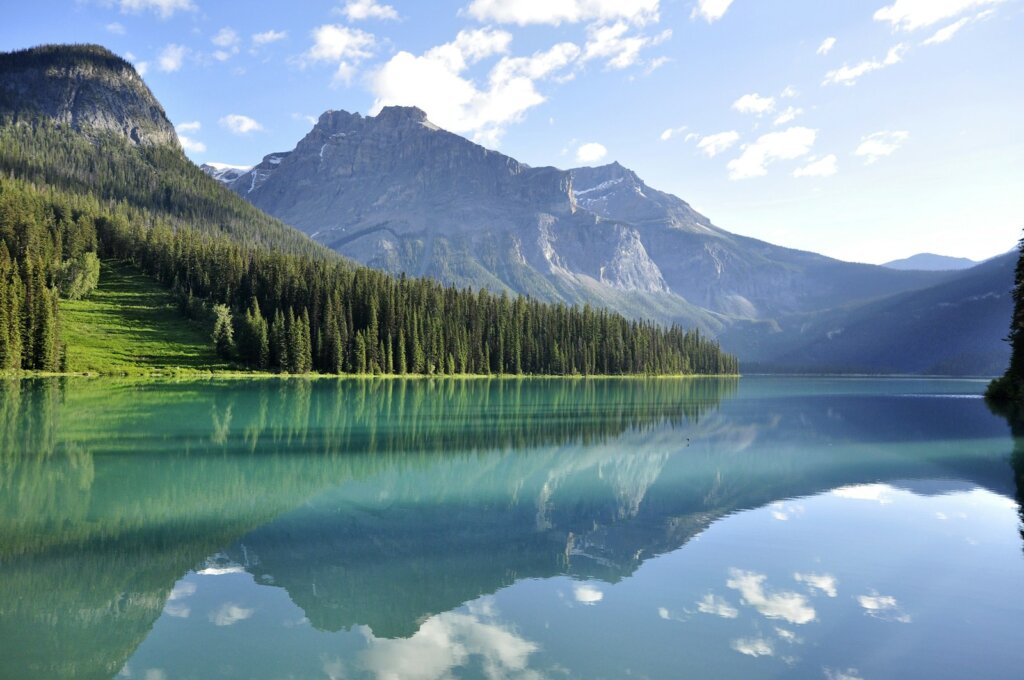
The Canadian Rockies are where most itineraries begin, and correctly so. The Icefields Parkway — 232 kilometres of highway connecting Lake Louise to Jasper through a corridor of glaciers, turquoise lakes and peaks that rise above 3,000 metres — is one of the great drives in the world, full stop. Not one of the great drives in North America. One of the great drives, measured against anything. The Columbia Icefield sits midway along it, a remnant of the last ice age covering 325 square kilometres, accessible from the roadside and comprehensible in a way that glaciers in more remote locations are not. Moraine Lake, in the Valley of the Ten Peaks, produces the kind of image that makes experienced travellers question whether they are looking at a photograph or a painting — the blue of the water, fed by glacial rock flour, is a colour that has no equivalent in nature elsewhere. Private vehicles cannot access the lake in summer; Parks Canada shuttles run from Lake Louise, and reservations for summer 2026 only opened in mid-April. Book immediately.
Jasper deserves specific mention as the recovery story of 2026. The July 2024 wildfires damaged significant parts of the townsite and burned more than 32,000 hectares of surrounding park. Jasper is open. The Icefields Parkway is fully operational. The wildlife — elk, black bear, the occasional grizzly crossing the highway with total indifference — is entirely undiminished. The fire-scarring near the townsite is visible and, in its own way, part of understanding a landscape that has been shaped by fire for millennia. The Columbia Icefield, Athabasca Glacier and Peyto Lake were untouched. Go.
For a contrast to mountain drama, Vancouver Island offers something quieter and equally powerful. The island’s west coast — Pacific Rim National Park Reserve, the surf beach at Long Beach, the old-growth rainforest of Cathedral Grove where Douglas firs stand at 800 years old and 76 metres tall — operates at a pace and scale that recalibrates the nervous system. Tofino, the surfing town at the island’s northwestern tip, has developed into one of Canada’s most interesting small destinations: serious cold-water surfing, outstanding seafood, a clutch of boutique properties including the Wickaninnish Inn, which has been doing considered luxury in a wild coastal setting for thirty years. It is the kind of place that people return to annually and struggle to explain to those who haven’t been.
The Great Bear Rainforest is one of the last great wildernesses in the northern hemisphere — a 6.4-million-hectare temperate rainforest on British Columbia’s central and north coast, accessible only by floatplane or boat, and home to the spirit bear, a rare white-coated black bear found nowhere else on earth. Seeing one is not guaranteed. The combination of old-growth forest, coastal inlets, salmon runs and the particular quality of the light in that latitude makes the journey worthwhile regardless. Lodge-based expeditions — Knight Inlet, Farewell Harbour, the Nimmo Bay resort — run from late summer into autumn when the salmon are running and the bears are most active. These are not budget trips. They are the kind of trips that people describe for the rest of their lives.
Beyond British Columbia, Canada’s lesser-told geography rewards the traveller willing to move laterally. Newfoundland is perhaps the most overlooked province in a country that does not oversell itself — a windswept island of extraordinary coastal scenery, Norse archaeological sites, icebergs drifting past fishing villages in May and June, and a local culture defined by music, storytelling and a directness that visitors find immediately disarming. St John’s, the capital, is one of the most characterful small cities in North America: Signal Hill, the battery neighbourhood of wooden houses above the harbour, and a live music scene that punches far above the city’s size. Skyscanner records St John’s as the ninth fastest-growing UK destination for 2026, with searches up 58% year-on-year. The travellers who have discovered Newfoundland tend not to keep it to themselves.
Nova Scotia belongs in the same conversation — a Maritime province of fishing villages, Acadian history and a coastline that delivers something different at every headland. The Cabot Trail on Cape Breton Island, a 298-kilometre loop through Highland scenery that would not look out of place in Scotland, is one of the continent’s most celebrated scenic drives. Baddeck, the small town where Alexander Graham Bell chose to spend his summers, sits on the Bras d’Or lake with a quietness that feels earned rather than engineered. The seafood — lobster, scallops, Digby clams — is the kind that reminds you what seafood is supposed to taste like when it has not travelled far.
Churchill, Manitoba sits far outside the mountain-and-coast circuit and justifies the detour entirely. In October and November, it is the polar bear capital of the world — the bears congregating on the western shore of Hudson Bay, waiting for the ice to form, viewable from tundra buggies at distances measured in metres rather than the polite distances of most wildlife encounters. In summer, the same coastline hosts beluga whales in numbers that make snorkelling among them — the water is cold, the visibility is extraordinary — feel like the most surreal decision you have ever made.
Two practical notes of genuine use. The pound buys around 1.85 Canadian dollars, making Canada meaningfully more affordable than it has felt for most of the past decade. Parks Canada is offering free admission to all national parks from 19 June to 7 September 2026 under the Canada Strong Pass initiative, with 25% off overnight stays — a concrete saving at peak season for the Rocky Mountain parks. UK passport holders need an eTA rather than a visa, available online for the equivalent of about £3.80. Direct flights from Heathrow reach Vancouver in under ten hours and Calgary — the gateway to Banff and the Rockies — in around nine and a half, with Air Canada and British Airways both operating the routes.
Canada is also co-hosting the FIFA World Cup this summer, with matches in Toronto and Vancouver running from 11 June to 19 July. For those combining cities with the national parks, the timing and the additional energy both cities carry during a tournament of that scale is worth factoring into an itinerary.
6. Kazakhstan
Kazakhstan is not a destination that reveals itself quickly. It is a country that rewards the traveller willing to sit with its scale before trying to make sense of it. Learn more about the best things to do in Kazakhstan here!
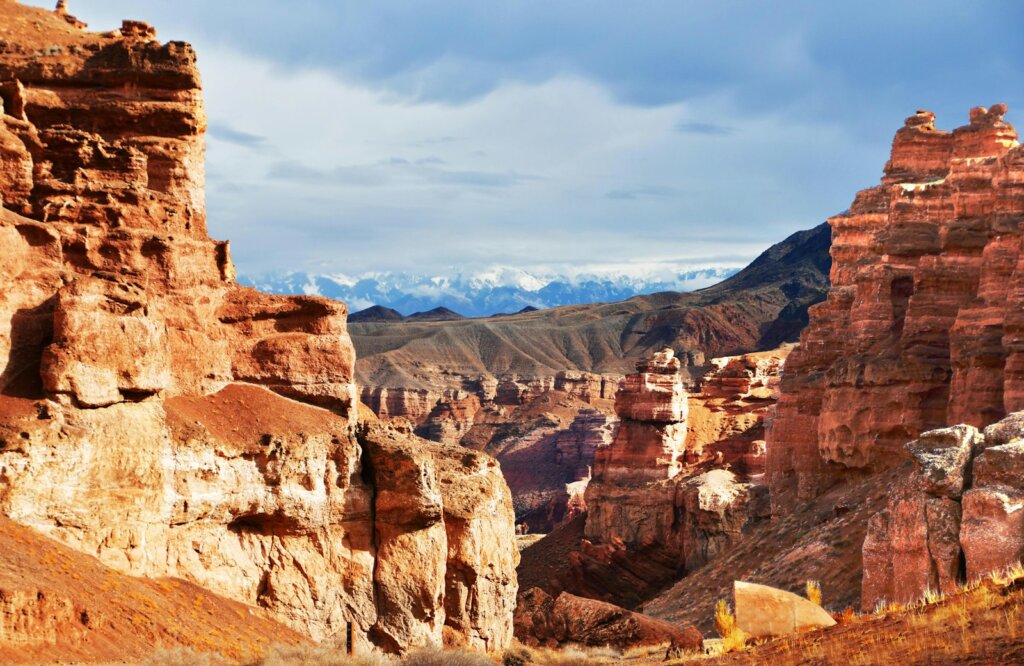
The ninth-largest country on earth — larger than Western Europe — Kazakhstan occupies a space in the Western travel imagination that bears almost no relationship to the country itself. What most people know, or think they know, is steppe and Soviet legacy and a name that ends in -stan. What they do not know is the Charyn Canyon at golden hour, when the red sandstone formations glow against a sky that has no competition for 200 kilometres in any direction. They do not know the Kolsai Lakes, three glacial bodies of water stacked up a valley in the Tian Shan mountains at altitudes that make the air feel different — cleaner, thinner, charged with something that cities have processed out of existence. They do not know the Kazakh Altai in high summer, where Mount Belukha rises to 4,506 metres above a landscape of meadows and rivers and old-growth forest that has been largely undisturbed because virtually nobody comes here. This is the version of Kazakhstan that changes how you think about travel.
Almaty is the base and the surprise. The former capital — replaced by Astana in 1997 in one of those Soviet-legacy planning decisions that still generates debate — is a city of wide boulevards, Soviet-era architecture softened by an improbable density of trees, and a food and leisure culture that most visitors do not expect and leave talking about. The Green Bazaar, a covered market of extraordinary abundance, is where Almaty’s culinary logic becomes clear: mountains of dried fruit and spice, horsemeat preparations in every form, dairy products that have no direct Western equivalent, and a hospitality culture that treats strangers at a table as guests rather than customers. The restaurant scene beyond the bazaar has developed rapidly — Georgian, Korean, Russian and contemporary Kazakh cooking sharing streets in a city that feels genuinely cosmopolitan. For wine drinkers, Kazakhstan produces its own — the vineyards of the Almaty region, benefiting from a continental climate of hot summers and cold winters, are producing bottles that are increasingly worth seeking out, and a tasting at one of the city’s specialist wine bars is a genuinely interesting evening rather than a novelty exercise.
The city’s sports infrastructure reflects a Central Asian ambition to build world-class facilities in a generation. Padel has taken hold in Almaty with a speed that mirrors its global trajectory — purpose-built clubs have opened across the city, courts are well-maintained, and the local playing standard is higher than you might expect. For golfers, the Nurtau Golf Club sits in the foothills of the Zailiysky Alatau with mountain views that few courses anywhere can match; equipment hire is available and green fees are a fraction of equivalent European clubs. The Shymbulak Mountain Resort, forty minutes from Almaty’s centre, offers skiing from late November through April on slopes that reach 3,200 metres, with a gondola system rebuilt to European standard and a piste network that suits intermediates and advanced skiers equally — at a price point that makes even Eastern European ski resorts feel expensive by comparison. The mountain access from a major city of this quality is, by any measure, exceptional.
Charyn Canyon, 200 kilometres east of Almaty on a road that is straightforward by Central Asian standards, is the comparison that travel writers always reach for and that is nevertheless accurate: a miniature Grand Canyon carved by the Charyn River through red and orange sedimentary rock, with formations rising to 300 metres in the Valley of Castles section. The light in the late afternoon turns the walls a colour that is difficult to name precisely — somewhere between ochre and rust and the orange of a fire seen from a distance. Overnight camping in the canyon, with no artificial light for miles, produces a sky of the kind that urban travellers have largely stopped expecting. Charyn is best combined with the drive east to the Kolsai Lakes — three interconnected alpine lakes in a valley that climbs from 1,818 metres at the lowest to 2,850 metres at the highest, each one a different shade of blue-green depending on the angle of the light and the season. The nearby Kaindy Lake, where a 1911 earthquake submerged a spruce forest and left the tree trunks standing above the water surface like grey masts, is one of those images that looks constructed and is not.
The Kazakh Altai — specifically Katon-Karagai National Park, a UNESCO Biosphere Reserve of 643,000 hectares in the country’s far east — is where Kazakhstan makes its most serious argument to the traveller who has seen most things. This is frontier wilderness: rivers that run with taimen, the world’s largest salmonid; valleys where golden eagles are worked by local hunters in a tradition that predates any state that has occupied this territory; forests that run to the Russian and Chinese borders without interruption. Mount Belukha, the highest peak in Siberia at 4,506 metres, sits at the junction of three countries and on the axis of what Altai shamanic tradition considers a sacred meridian. The journey to get here — Almaty to Ust-Kamenogorsk by air, then road east — is part of the experience. This is not a destination with infrastructure designed around visitor comfort. It is a destination that assumes a certain self-sufficiency, and that assumption is correct.
The self-drive question is legitimate and navigable. Roads between Almaty and the main southern destinations — Charyn, Kolsai, the Charin valley — are paved and manageable in a standard vehicle. The further east and north you travel, the more the road quality becomes advisory rather than guaranteed. Fuel logistics require planning; Kazakh hospitality on remote routes is, in practice, a form of infrastructure — the culture of offering food, shelter and assistance to travellers is genuine and deep-rooted rather than performed. A 4×4 for the Altai and the more remote steppe routes is not caution. It is planning.
The dark tourism dimension of Kazakhstan is significant and should not be sanitised. The Semipalatinsk Test Site — the Polygon — in the country’s northeast is where the Soviet Union conducted 456 nuclear tests between 1949 and 1989, 116 of them above ground, in a decision made with full knowledge that a city of 150,000 people lived within range of the fallout. The site is accessible, partially remediated and still inhabited in parts by communities dealing with multigenerational health consequences. Visiting it is not straightforward and not comfortable. It is one of the most sobering experiences available to a traveller anywhere in the world, and it contextualises the Soviet legacy that shaped this country more directly than any museum exhibit.
Air Astana operates the only direct London Heathrow to Almaty service, around 8 hours 10 minutes on an Airbus A321LR. UK passport holders are visa-free for 30 days. The pound buys roughly 630 tenge, making Kazakhstan genuinely affordable in absolute terms. Almaty’s new Terminal 2 — a $200 million facility that opened in June 2024 — has transformed the arrival experience into something that matches the ambition of the city beyond it. Digital infrastructure is solid in Almaty and the main tourist corridors; on the steppe and in the Altai, connectivity is intermittent and a downloaded offline map is not optional.
Nomadical Tracks has been to Kazakhstan and covered it in depth. For a full breakdown of where to go and what to do, read our Best Things To Do in Kazakhstan guide — and follow the series on the channel.
7. Finland
Finland does not perform for visitors. It simply exists — at a scale, a quietness and a quality that most travellers are entirely unprepared for.There is a reason Lonely Planet named Finland in its Best in Travel 2026, and it is not the aurora. Or rather, it is not only the aurora.
It is the particular combination of wilderness and civilisation that Finland has developed with a restraint that feels almost philosophical — a country that has built world-class infrastructure and then arranged it carefully around an environment it has no interest in compromising. The result is a destination that delivers differently depending on the season you choose, but that delivers at the same level regardless.
Lapland in winter is the version most UK travellers know, and the version that most undersells itself in the telling. The photographs of glass igloos and frozen rivers and huskies running through birch forest are accurate, but they do not capture the texture of actually being there — the silence, which is not the absence of sound so much as a positive physical presence; the cold, which at minus twenty degrees becomes less uncomfortable than clarifying; the particular quality of the Arctic light in late afternoon, which turns everything the colour of something just about to happen. Rovaniemi — the capital of Lapland, rebuilt entirely after being burned to the ground by the retreating German army in 1944, and designed by Alvar Aalto in the shape of a reindeer — is the natural base. The aurora borealis is visible from the city on clear nights, but the serious sighting requires movement: a husky safari into the forest, a snowmobile expedition to a frozen lake, a night at one of the glass igloo properties where the ceiling is the point.
Kakslauttanen Arctic Resort at Saariselkä — 250 kilometres north of Rovaniemi, which is itself already well above the Arctic Circle — built the world’s first glass igloos in 1999 and remains the benchmark for the format. The thermal glass holds warmth while admitting the aurora above; the resort adds husky safaris, reindeer sleigh rides and a smoke sauna of genuine cultural weight. The light pollution here is zero in any meaningful sense. 2026 is an unusually good year for aurora activity — Solar Cycle 25 is at or just past its maximum, producing geomagnetic conditions that extend the season and intensify the displays. Peak months are September to October and February to March, when darkness is sufficient and clear skies most likely. The traveller who books Lapland in February 2026 is making a decision with the odds in their favour.
The winter activity circuit around Rovaniemi is deeper than most visitors reach. Snowmobile expeditions through the Urho Kekkonen National Park — 2,550 square kilometres of wilderness with no roads and considerable wildlife — are a full-day proposition that bears no resemblance to the resort-managed version of the activity. Ice fishing on a frozen lake, cut through several feet of ice to drop a line into water that has not seen daylight since October, is one of those experiences that sounds marginal and turns out to be the one you talk about most. Reindeer herding with a Sami family — the indigenous people of Lapland, whose culture and land rights predate the Finnish state — is available through a small number of operators and belongs in a different category to the conventional tourism experience entirely.
Helsinki rewards more time than most Lapland itineraries allow for it. The Finnish capital is compact, walkable and operating at a level of design intelligence that makes it one of the most quietly impressive city breaks in northern Europe. The Market Hall on the waterfront, the modernist masterpieces of the Temppeliaukio church and the Finlandia Hall, the Design District’s concentration of studios and independent shops — Helsinki has a coherence that reflects a country that takes the built environment seriously.
The food scene has developed substantially: Olo and Grön hold Michelin stars, the fish market by the harbour serves the morning catch with an informality that is entirely genuine, and the coffee culture — Finland is the world’s highest per-capita coffee consumer — means that the cafés function as a form of infrastructure. An overnight before heading north is the minimum. Two nights is better.
Oulu, four hours north of Helsinki by the new Pendolino Plus train service, is European Capital of Culture 2026 — a designation that has brought a programme of exhibitions, performances and public installations to a city on the Gulf of Bothnia that most international visitors have never considered stopping in. The designation is temporary; the city’s character — a university town of 200,000 people with an unusually active arts and music scene and a cycling culture that persists through the Arctic winter — is not.Finland in summer is a different country and an equally compelling one. The lake district — covering roughly a third of the country’s interior, 188,000 lakes connected by rivers and channels into a navigable system of extraordinary scale — operates in a light that does not fully disappear from late May to late July.
The midsummer sun that never sets is disorienting for the first night and addictive by the third. The archipelago along the southwestern coast — 40,000 islands ranging from inhabited farming islands to bare rock in the open Baltic — is navigated by ferry and bicycle, at a pace that the Finns call sisu in one context and hiljaisuus — quietness — in another. Neither word translates precisely. Both describe something the archipelago delivers without effort.Sauna is not an amenity in Finland. It is a cultural institution, a social ritual and, for many Finns, a form of spiritual practice. The country has approximately 3.3 million saunas for a population of 5.5 million. The correct version is wood-fired, reached through forest or built over a lake, followed by a swim in water that is cold enough to eliminate every thought except the immediate one. The public saunas of Helsinki — Löyly, Allas Sea Pool, the recently restored Kotiharju, which has operated continuously since 1928 — are the urban introduction to a practice that becomes, for most visitors who engage with it properly, the thing they miss most when they leave.
Finnair operates direct services from Heathrow to Helsinki in around two hours fifty-five minutes, with multiple weekly departures. For Rovaniemi, winter charter flights operate direct from several UK airports including Gatwick, Luton, Manchester, Bristol and Edinburgh. No visa is required. The pound buys around €1.15. Finland set a record for foreign overnight stays in 2025 — 7.2 million, up 12% year-on-year — and 2026 is tracking ahead of that.
The travellers arriving are not discovering something new. They are arriving at a conclusion that the evidence has been pointing to for some time
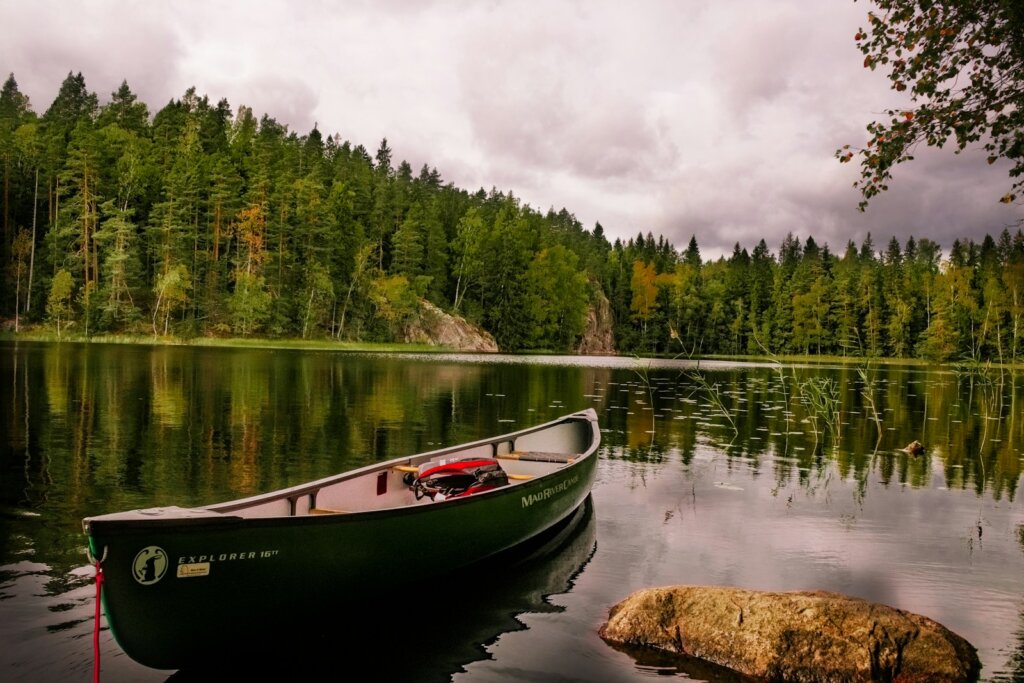
8. United Kingdom
The best argument for travelling the United Kingdom in 2026 is not convenience. It is quality — and the two happen to coincide.
There is a version of the domestic travel conversation that frames the UK as a fallback, the sensible choice made in the absence of something better. That conversation is having the wrong argument. The Scottish Highlands contain some of the most dramatic landscape in Europe. The Northumberland coast is wilder and less visited than comparable stretches of coastline in Portugal or Croatia. The Yorkshire Dales produce food at a level that renders the journey from London not just worthwhile but specifically motivated. The traveller who chooses the UK in 2026 is not settling. They are editing — removing the flight, the transfer, the time zone adjustment, and arriving somewhere that requires no acclimatisation before it starts delivering.
Sykes Holiday Cottages reports forward bookings up 9% year-on-year for 2026. VisitBritain estimates 12.5 million Britons planned overnight domestic trips over Easter weekend alone. The domestic travel market is not growing because the alternatives have become too expensive. It is growing because people are beginning to reckon honestly with what is already here.
The Scottish Highlands are the natural starting point for that reckoning. The landscape needs no salesmanship — a drive along Loch Ness in the morning light, the Torridon mountains rising from the water in the northwest, the Cairngorms plateau in late autumn when the birch and heather are doing something that photographs have been failing to capture adequately for 150 years. What has changed in the past decade is the quality of where you stay within that landscape. The Fife Arms in Braemar — a 47-room Victorian shooting lodge restored by art world figures Iwan and Manuela Wirth into something that functions simultaneously as a hotel, an art collection and a community institution — holds two Michelin Keys and operates at a level of considered luxury that holds its own against properties anywhere in the world. The Torridon in Wester Ross, built in 1887 on 58 acres above Upper Loch Torridon, pairs a Michelin-recommended restaurant with a whisky bar of over 365 expressions and a wilderness activity programme — guided ridge walks, sea kayaking, stag safaris — that treats the surrounding landscape as the primary amenity rather than the backdrop. Killiehuntly Farmhouse in the Cairngorms, part of Anders Holch Povlsen’s WildLand portfolio, is a 17th-century property sleeping eight that operates with the quiet conviction that rewilding and exceptional hospitality are not competing priorities.
For those seeking genuine isolation with connectivity — the remote working trip, the founder retreat, the week that is structured around thinking rather than tourism — the Highlands deliver a combination that European equivalents struggle to match. The infrastructure of solitude here is real: fast broadband in properties that look over sea lochs, morning air that clears the head with a reliability that no wellness programme has yet managed to bottle, evenings that extend across a horizon with no competing claim on your attention.
Northumberland makes a quieter and equally serious case. The least densely populated county in England, it runs from Hadrian’s Wall in the south to the Scottish border in the north, with a coastline of dune-backed beaches — Bamburgh, Seahouses, Alnmouth — that belongs in a different conversation to the Northumberland most people have in their heads. Bamburgh Castle, standing on a basalt outcrop above the beach with a directness that the word dramatic undersells, is one of the great visual experiences in England on a clear winter morning. The Farne Islands, accessible by boat from Seahouses between April and October, host one of the largest grey seal colonies in Europe and, in season, puffin numbers that create the particular chaos of a colony operating at full capacity.
The headline story in Northumberland in 2026 is the dark sky. Northumberland International Dark Sky Park — the largest in England, covering 1,500 square kilometres — has developed a serious astronomical infrastructure around its designation. Kielder Observatory, perched above the reservoir at 370 metres, runs public observation evenings and specialist events through the year, and its partnership with The Twice Brewed Inn near Hadrian’s Wall delivers 30-seat planetarium sessions in a setting that combines Roman history with a sky that has no meaningful light competition in any direction. The observatory’s planned £8.5 million Astronomy Village — a 60-seat planetarium, a one-metre aperture wheelchair-accessible telescope — will make Northumberland one of the most significant dark sky destinations in Europe when it opens.
Pembrokeshire in West Wales offers a different proposition again — a National Park of coastal path, offshore islands and a light that changes the colour of the sea four times before noon. The Pembrokeshire Coast Path, 186 miles of clifftop walking from Amroth to St Dogmaels, is the serious undertaking; the day walks around St David’s Peninsula, the Marloes Peninsula and the headlands above Solva are accessible without a multi-day commitment and deliver the same quality of view. Skomer Island, a 20-minute boat crossing from Martin’s Haven, holds one of the largest puffin colonies in southern Britain — 43,626 birds counted in the 2025 survey — accessible on day trips from April through August. A note for 2026: overnight commercial trips to Skomer ended this year, with the Wildlife Trust moving to day visits only. Plan accordingly.
The hotel tier in Pembrokeshire has developed quietly but substantially. Twr y Felin in St David’s — Wales’s first contemporary art hotel, 39 rooms built around a 19th-century windmill — holds three AA Rosettes and operates at a level of design seriousness that the coastal setting makes feel entirely natural rather than incongruous. Roch Castle, a 12th-century fortified tower converted into a six-room hotel above St Brides Bay, offers the particular luxury of sleeping inside a medieval structure with the Atlantic visible from every window. The Grove of Narberth, set in 26 acres of Pembrokeshire countryside, runs a kitchen that treats the surrounding farmland as both supplier and argument.
The Yorkshire Dales close the case for the UK on food and landscape simultaneously. The Dales are a particular kind of English beautiful — drystone walls running over limestone hills, market towns of grey stone, rivers that run clear and fast through valleys that seem to have been arranged with a deliberate sense of composition. Malham Cove, a 70-metre curved limestone cliff that doubles as a natural amphitheatre, and the stepped waterfalls of Aysgarth are the landmark stops on any itinerary. The Angel at Hetton, the Dales’ only Michelin-starred restaurant, operates out of a 15th-century drovers’ inn and cooks with an understanding of the local landscape that is evident in every course — this is not fine dining that happens to be in the countryside. It is fine dining that could only exist in this countryside. Grantley Hall in Ripon — winner of Best Spa Hotel UK at the Global Spa Awards 2026 and recently the subject of a four-part Channel 5 documentary — represents the luxury tier of the Dales at full confidence: 47 rooms in a Grade II listed 17th-century house, with a spa programme and a food and drinks offering that has no interest in apologising for its ambitions.
The train-accessible dimension of UK domestic travel is worth naming as a convenience argument rather than a moral one. London to Inverness in around eight hours. London to Carlisle — gateway to the Lake District and Northumberland — in three and a half. London to Cardiff in two, with Pembrokeshire two hours further by rail and road. The absence of a boarding pass, a luggage allowance anxiety or a 5am departure is not a small thing when the destination at the other end of the journey is genuinely worth arriving at.
No passport. No visa. No exchange rate to monitor. No jet lag to burn off before the trip begins to deliver. The UK in 2026 asks very little of the traveller and returns, in the right corners of it, more than most people expect it to.
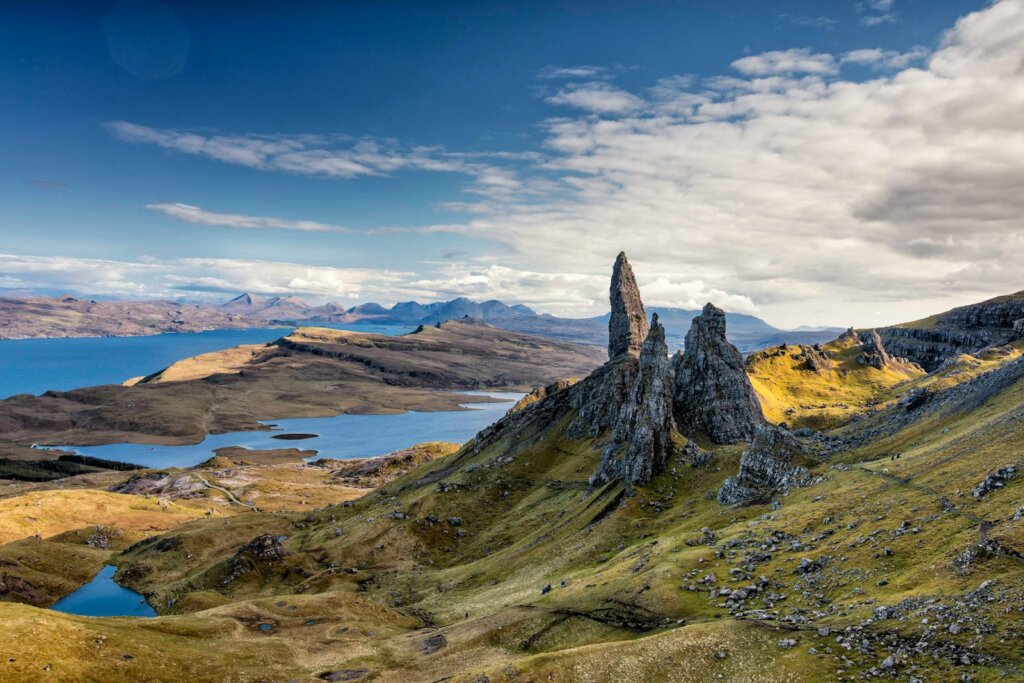
9. Estonia
Estonia is the destination that serious travellers discover and immediately stop telling people about.
Not out of selfishness, exactly. More because the gap between what Estonia costs and what it delivers is wide enough that sharing it freely feels like a betrayal of something. A medieval city of extraordinary preservation. A national park an hour from the capital that most visitors never reach. A craft beer culture that has developed with the same rigorous intelligence Estonia applies to everything. Golf courses that benchmark against the best in the Baltics at a fraction of Scandinavian pricing. And a disc golf circuit that makes this small Baltic state, per square kilometre, the most course-dense nation on earth — a niche that has built a genuine international travel community around it and that brings players from across Europe and North America to a country they would not otherwise have considered visiting. Two hours forty-five minutes from London. No visa. Change at a price point that embarrasses Western Europe at every turn.
The case for Estonia in 2026 is not that it is undiscovered — Tallinn received 3.4 million foreign visitors in 2024, more than Riga or Vilnius — but that it is consistently underestimated. The people arriving tend to have low expectations. The people leaving tend to have revised them substantially.
Tallinn’s Old Town is the entry point, and it earns its UNESCO World Heritage designation with an unusually high degree of architectural integrity. Most medieval old towns in Europe exist in a state of partial restoration, the original fabric interrupted by later centuries of development and war. Tallinn’s is different — the Hanseatic merchant city of the 13th to 15th centuries survives here in a form that is, by European standards, remarkably complete. The limestone towers of the city wall, the Gothic Town Hall on Raekoja plats, the Great Guild Hall, the Church of the Holy Spirit with its 1684 clock still marking the hours on the exterior wall — these are not reconstructions or approximations. They are the buildings, still standing, still in use in most cases, occupying the same streets and sight lines they have held for six centuries. The upper town, Toompea, adds the cathedral, the Danish king’s garden, and a terrace view over the red rooftops of the lower city that explains in a single image why Tallinn has the reputation it does.
What most visitors miss is the city immediately beyond the medieval walls. Kalamaja, the former working-class district of wooden houses northwest of the Old Town, has become the neighbourhood where Tallinn’s actual contemporary life is happening — a concentration of independent cafés, design studios, natural wine bars and restaurants that reflects a city with genuine creative energy rather than one performing it for tourists. The Telliskivi Creative City, a converted industrial complex in the heart of Kalamaja, houses galleries, makers’ studios, a weekend market and the kind of street food offer that belongs in a larger city. The Fotografiska Tallinn — the Estonian outpost of the Stockholm photography museum — occupies a converted limestone building on the edge of the Old Town and runs a programme that takes the medium seriously.
Lahemaa National Park is the case for staying longer than a long weekend. Estonia’s oldest and largest national park, 747 square kilometres of coastal forest, bog and farmland an hour east of Tallinn along the E20, is where the country’s landscape logic becomes fully legible. The Viru Bog boardwalk — a 5.7-kilometre trail through an ancient raised bog on a wooden walkway that keeps you above the water table — is one of those experiences that sounds unremarkable in description and turns out to be quietly arresting in practice: the silence, the particular vegetation of a peat ecosystem unchanged in structure since the last ice age, the open water of the bog pools reflecting a sky with nothing between you and it. The trail takes around two hours and requires no specialist equipment. The Jägala Waterfall, Estonia’s highest natural waterfall at 8 metres — the country is flat; 8 metres is a significant geological event here — sits 30 minutes from Tallinn and is worth the detour for the river valley walk alone. The Palmse and Sagadi manor houses within the park, both restored Baltic German estates from the 18th century, offer context for the social history of a region that changed hands between Denmark, the Livonian Order, Sweden, Russia and the Soviet Union before arriving at independence in 1991.
Disc golf in Estonia is not a curiosity. It is a national sport with a playing population of over 20,000, a professional circuit that has produced world-ranked players including former world number one Kristin Lätt, and a course network of around 200 layouts across a country the size of the Netherlands. The 2026 Disc Golf Pro Tour includes a European Major in Estonia — a significant event that will bring the sport’s top professionals to a destination built for the activity. The courses near Tallinn — Männiku Wakepark, Kurna, Discland — are accessible within 30 minutes of the city centre. The destination courses further afield, including Kõrvemaa Disc Golf Park and the layouts at Alutaguse in eastern Estonia, justify multi-day trips in their own right. For the travelling disc golfer, Estonia is not one of the options. It is the primary destination in Europe.
Golf in the conventional sense has developed alongside the disc golf culture, driven by the same logic: land is available, construction costs are a fraction of Western European equivalents, and the playing season from May to October delivers conditions that are consistently good without the summer heat that makes southern European courses punishing by midday. Estonian Golf & Country Club at Jõelähtme, 25 minutes from Tallinn, operates two courses with sea views over the Gulf of Finland and a clubhouse that reflects the country’s design intelligence. Green fees are low by any European comparison.
The craft beer scene is the other dimension that rewards engagement. Estonia’s microbrewery culture developed in the mid-2010s with a rigour that reflected a broader cultural confidence — a small country that, having re-established its identity after Soviet occupation, was applying the same seriousness to brewing that it was applying to technology, design and public governance. Põhjala, Lehe Pruulikoda, Tanker and Õllenaut are among the breweries producing work that belongs in the European craft conversation, available in taprooms and bottle shops across Tallinn and increasingly in bars throughout the country. A craft beer evening in Kalamaja — moving between taprooms that take the product as seriously as any wine bar takes its list — is a better night than most visitors to Tallinn plan for themselves.
A practical note on Rail Baltica for those planning ahead: the 870-kilometre new-build high-speed rail line connecting Tallinn to Warsaw via Riga and Kaunas is under full construction, with Phase 1 now targeted for 2030. It is not a 2026 option but a future game-changer that will transform Estonia’s connectivity to the rest of Europe within this decade.
Ryanair, Wizz Air and airBaltic operate between London and Tallinn from around £55 return in shoulder season. The pound buys €1.15. No visa is required. Estonia uses the euro, which removes any currency friction for European travellers. The country is compact enough to drive across in three hours, which means the logic of renting a car and moving between Tallinn, Lahemaa, the western islands of Saaremaa and Hiiumaa, and the university city of Tartu in the south — Estonia’s intellectual capital, smaller and quieter than Tallinn, with a riverfront and a university culture that gives it a distinct character — holds across even a short trip.
Estonia rewards the traveller who asks more of it than a weekend in the Old Town. The Old Town is worth the trip. Everything beyond it is the reason to come back.
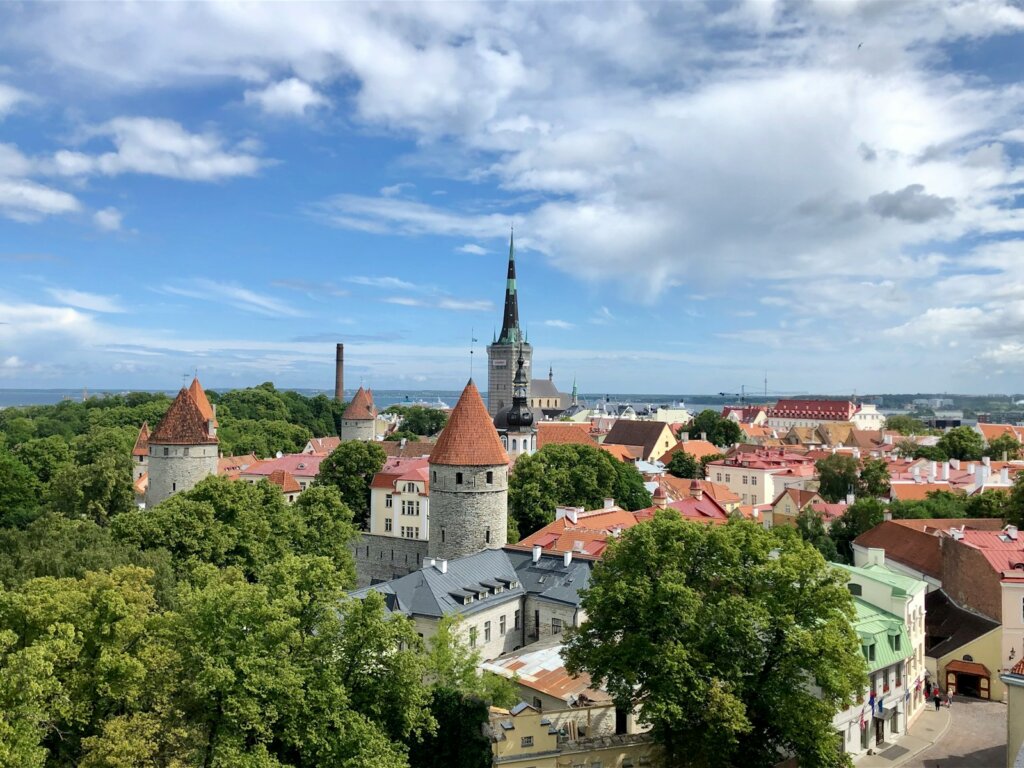
10. Senegal
West Africa has been on the periphery of the mainstream travel conversation for long enough. In 2026, with Dakar hosting the first Olympic event ever held on African soil, that is about to change.
Senegal has always been West Africa’s most accessible entry point — politically stable in a region where stability is not guaranteed, genuinely welcoming in a way that is cultural rather than commercial, and possessed of a capital city with enough creative and intellectual energy to sustain serious engagement well beyond the standard tourist circuit. What it has lacked until recently is the kind of infrastructural moment that accelerates international attention. The Youth Olympic Games, running from 31 October to 13 November 2026, is that moment. The travellers who arrive before the narrative shifts tend to get the better version of the destination. Senegal in 2026 is that opportunity.
The concept of teranga — the Wolof word for hospitality that has no precise English equivalent, encompassing generosity, welcome and a genuine orientation towards the guest — is not a marketing construct. It is a cultural reality that shapes interactions at every level, from the family-run auberge in the Casamance to the street vendor in Dakar’s Plateau district who stops what he is doing to help a visitor find a street they are looking for. Senegal is one of those countries where the human texture of the place is as much the experience as the landscape or the history, and where that texture is encountered almost immediately on arrival rather than after days of navigation.
Dakar is the start and, for many visitors, an extended stay in itself. The city sits on the Cap-Vert Peninsula, the westernmost point of the African continent, with the Atlantic on three sides and an energy that reflects a capital processing significant change at significant speed. The Plateau district — the colonial-era administrative centre of French West Africa, now home to government buildings, embassies and a gallery and restaurant scene that has emerged from Senegal’s growing art market presence — is the obvious anchor. The IFAN Museum of African Arts, one of the oldest and most significant collections of sub-Saharan African art on the continent, occupies a building from 1936 and runs a permanent collection of masks, textiles, musical instruments and ceremonial objects that contextualises what you will see in the markets and villages beyond the city with a depth that few single museum visits achieve.
The music deserves particular attention. Dakar is the city that gave the world mbalax — the percussion-driven, Cuban-inflected dance music that Youssou N’Dour made internationally legible in the 1980s and that continues to evolve in the live music venues of the Medina and Yoff neighbourhoods with a vitality that suggests a tradition nowhere near its conclusion. An evening at a live music space in Dakar — the Just4U club, the outdoor venues that animate the beach districts on weekends — is not a cultural tourism experience in the managed, staged sense. It is a night out in a city that takes music as seriously as food.
The food itself operates with a confidence rooted in a cuisine that has been largely ignored by the international food conversation and is entirely indifferent to that fact. Thiéboudienne — rice cooked in tomato and fish broth with vegetables, the national dish, prepared differently by every household and every restaurant in Senegal — is one of those foundational dishes that rewards repeated encounters rather than a single definitive version. Yassa poulet, chicken marinated in lemon juice and onions and grilled over charcoal, has the clarity of a dish that has been refined over generations. The street food circuit of Dakar — from the sandwiches of the Plateau to the grilled fish stalls of the corniche to the Lebanese-influenced shawarma that reflects the city’s long commercial history — is the kind of eating that rewards wandering over planning.
Gorée Island sits 3 kilometres off the Dakar coast, a 20-minute ferry ride from the Port de Dakar, and operates on a completely different register to the mainland city. A car-free island of bougainvillea-covered colonial buildings and quiet lanes, it was one of the major holding points for enslaved people during the transatlantic slave trade — a history physically embodied by the Maison des Esclaves, the 18th-century slave house whose Door of No Return opens directly onto the ocean at the point from which captives were loaded onto ships. The house is small and the guided visit takes less than an hour. It is among the most quietly devastating historical experiences available to a traveller anywhere in the world. The island beyond it — the galleries, the restaurants in colonial courtyards, the view back to the Dakar skyline from the northern ramparts — provides a gentler frame, but the Door of No Return is what Gorée is, and it should be engaged with directly rather than briefly.
North of Dakar, the Djoudj National Bird Sanctuary in the Senegal River delta near Saint-Louis is a UNESCO World Heritage Site of a different kind of intensity altogether. The third-largest bird sanctuary in the world and the first significant wetland south of the Sahara, Djoudj receives between November and April a migration of extraordinary scale — three million birds, including the largest single colony of great white pelicans in Africa, arriving from European and Central Asian breeding grounds to winter in the delta. The pelicans move in formations of several hundred birds at a time, feeding in the shallow channels in coordinated groups that operate with a collective intelligence visible from the observation platforms and the flat-bottomed boats that navigate the sanctuary’s interior. Djoudj is best reached from Saint-Louis, the former capital of French West Africa — a UNESCO-listed colonial city on an island in the Senegal River, its narrow streets and faded grandeur a quieter and more contemplative destination than Dakar, with a jazz festival in May that draws musicians from across the continent.
Saly and the Petite Côte south of Dakar provide the beach dimension — a 150-kilometre stretch of Atlantic coastline of wide sandy beaches, warm water and a developing resort infrastructure that still trades at prices that reflect where Senegal is in its tourism trajectory rather than where it is heading. Cap Skirring, at the southern end of the Casamance region, is the most undeveloped and most beautiful section — a fishing village with a beach that competes with anything in West Africa and a small collection of boutique properties that have found the right register between comfort and authenticity.
Niokolo-Koba National Park in the southeast — a UNESCO World Heritage Site covering 913,000 hectares of Sudano-Guinean savanna — remains one of West Africa’s most significant wildlife reserves, with populations of lion, leopard, chimpanzee, hippopotamus and the Derby eland, the world’s largest antelope. Access is not straightforward and the infrastructure is basic by southern African standards. The wildlife populations have declined significantly from historic levels due to poaching pressure. The park rewards the traveller who goes with realistic expectations and a tolerance for the rough edges of frontier wildlife tourism — and who understands that what they are seeing, imperfect as the conditions may be, is one of the last functioning large mammal ecosystems in West Africa.
Practical notes require honesty. There are no direct flights from the UK to Dakar — the standard routings are via Casablanca with Royal Air Maroc, Paris with Air France, or Brussels with Brussels Airlines, with total journey times of eight to ten hours. The Train Express Régional Phase 2, the 19-kilometre extension from Diamniadio to Blaise Diagne International Airport, is scheduled to begin operations in the first half of 2026, connecting the airport to central Dakar in around 45 minutes and significantly improving the arrival experience. Infrastructure beyond Dakar remains variable — Senegal is a developing destination in the honest sense, and the traveller who arrives expecting the service consistency of Morocco or South Africa will need to recalibrate. The traveller who arrives understanding that the gap between what Senegal asks of you and what it returns is precisely that — a gap, not a deficit — will find a country of extraordinary generosity, specificity and depth.
UK passport holders are visa-free for three months. The West African CFA franc is pegged to the euro, removing currency volatility from the planning equation. The Youth Olympic Games run from 31 October to 13 November. The travellers who arrive before an event of that magnitude tend to find a city at its most confident and least self-conscious — presenting itself fully, on its own terms, to a world that is only beginning to pay attention.
Senegal is not the easiest destination on this list. It is one of the most rewarding. That relationship between effort and return is, in the end, what travel is for.
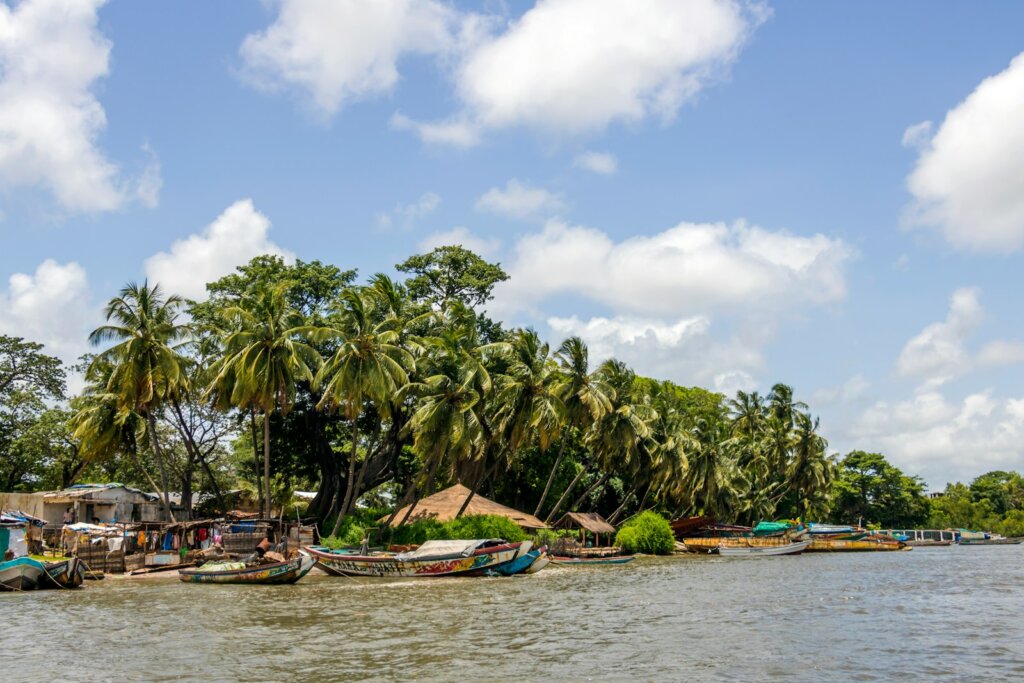
11. Georgia
Georgia is the country that keeps appearing on best destination lists and keeps being underestimated anyway — which is, at this point, its own form of distinction.
It is one of the oldest wine-making civilisations on earth, a country of Caucasian mountain scenery that operates at a scale and drama that the European Alps cannot match for sheer untamed quality, a capital city whose old town is among the most characterful in the former Soviet space, and a food culture so specific and so confident that it has been quietly influencing serious chefs for a decade without receiving proportionate credit. It is also, for UK travellers, a five-hour flight from London and visa-free for a year. The case is not complicated. Georgia simply requires the decision to go.
Tbilisi is where the argument becomes immediately legible. The old town — Dzveli Tbilisi — tumbles down the banks of the Mtkvari River in a confusion of carved wooden balconies, domed sulphur baths, Orthodox churches and medieval fortifications that produces an architectural texture found nowhere else in the Caucasus. The Narikala Fortress, a 4th-century citadel restored and ruined in turn by Arab, Mongol and Persian invasions, rises above the old town and provides a view of the city’s logic from above — the river bend, the cliff, the density of the lower quarter pressing up against the rock face. Below it, the Abanotubani district is built around the sulphur springs that have defined Tbilisi since its foundation myth, which attributes the city’s discovery to a 5th-century Georgian king whose hunting falcon fell into a hot spring and emerged cured. The bathhouses — domed, subterranean, smelling of minerals and steam — operate as they have for centuries, offering private rooms with plunge pools fed by genuinely thermal water. An hour in an Abanotubani bathhouse with a Georgian scrub and massage is not a spa experience. It is a form of municipal infrastructure that the city has been providing since the medieval period.
The food of Georgia is the other immediate argument. Georgian cuisine is built around a handful of foundational dishes that reward repeated encounters rather than a single definitive version — khinkali, the twisted-top dumplings filled with spiced meat broth that require a specific technique to eat without losing the soup inside them; khachapuri, the cheese-filled bread that takes a different form in every region of the country, from the boat-shaped Adjarian version topped with a raw egg and butter to the circular Imeretian version that is closer to a flatbread; shkmeruli, a whole roasted chicken cooked in a sauce of garlic and cream that is one of those dishes that makes you question why it is not on every menu in the world. Beyond the classics, the Georgian table operates on the principle of abundance — a supra, the traditional feast presided over by a tamada or toastmaster, involves dishes arriving in waves, wine poured continuously, and toasts of genuine literary ambition that address love, family, the dead, the living, friendship and the future in an order that has remained broadly consistent for centuries. Being invited to a Georgian supra is not a cultural tourism experience. It is one of the most generous acts of hospitality available in travel.
Wine is where Georgia’s depth becomes extraordinary. The country has been making wine for 8,000 years — longer than any other wine-producing nation on earth — and the tradition of fermenting grape juice in qvevri, large clay vessels buried underground, is a UNESCO Intangible Cultural Heritage that produces wines of a character found nowhere else. The Kakheti region, two hours east of Tbilisi, is the heart of Georgian wine production — a valley of vineyards backed by the Greater Caucasus range, where the village of Sighnaghi, a walled hilltop town above the Alazani plain, provides both a visual argument for the landscape and a concentration of natural wine producers working with ancient grape varieties that the rest of the world’s wine trade has barely begun to catalogue. Rkatsiteli, Saperavi, Mtsvane, Kisi — these are not wines you have encountered unless you have been looking specifically, and the qvevri versions, amber-coloured from extended skin contact, structured and tannic and alive in a way that conventional white wines are not, represent one of the most genuinely distinctive sensory experiences available to a wine-curious traveller anywhere. A day moving between family wineries in Kakheti — tasting from the qvevri in a cellar that has been in continuous use for generations, eating churchkhela, the walnut-and-grape-juice candy that hangs in every market, watching the Caucasus change colour in the afternoon light — is an argument for Georgian wine tourism that no article has yet adequately made.
The Greater Caucasus is the landscape dimension, and it operates at a scale that recalibrates whatever you thought you knew about mountain scenery. The Kazbegi region, three hours north of Tbilisi on the Georgian Military Highway — a road that crosses the Jvari Pass at 2,395 metres and follows river gorges of theatrical drama — delivers its most famous image immediately: the Gergeti Trinity Church, a 14th-century monastery perched on a 2,170-metre spur above the town of Stepantsminda, with Mount Kazbek — 5,047 metres, permanently glaciated — rising directly behind it. The photograph is everywhere. The reality is more affecting — the walk up from the town takes around two hours through meadows and switchbacks, and the monastery, still active, still used for religious services, sits at an altitude where the clouds are sometimes below rather than above you. The hiking in Kazbegi beyond the monastery trail is serious and largely untracked — multiday routes into the high valleys, glacier approaches, ridge walks that require navigation rather than signposting. The infrastructure of the town itself has developed rapidly: boutique guesthouses, a handful of genuinely good restaurants, a road that is now paved for most of its length from Tbilisi. Kazbegi in 2026 is at the precise moment where it is accessible without being crowded, comfortable without being managed. That moment does not last indefinitely.
Gudauri, an hour south of Kazbegi on the Military Highway, is one of Europe’s most genuinely underrated ski resorts — sitting between 2,200 and 3,279 metres, with a consistent snowpack from December through April, a modern gondola system rebuilt substantially in the past five years, and green fees — lift passes, accommodation, food — at a price point that makes comparable Austrian or French resorts feel like a different financial conversation. The terrain suits intermediate and advanced skiers, the off-piste access is significant, and the views from the upper lifts — across the Greater Caucasus towards Russia, with the Military Highway visible far below — provide the kind of context that purpose-built resorts elsewhere rarely manage. Heli-skiing is available from Gudauri into terrain that most European operators cannot reach. The après scene is Georgian in the best sense: large tables, long evenings, wine from qvevri rather than the glass.
Svaneti in the northwest is the region for the traveller who wants to go further. The high valleys of Upper Svaneti, accessible by a road that is partly paved and entirely memorable, contain a series of medieval tower villages — Mestia and the more remote Ushguli, one of the highest continuously inhabited settlements in Europe at 2,200 metres — where defensive stone towers built between the 9th and 13th centuries rise above houses that are still occupied, still working, still agricultural in the most direct sense. Ushguli is a UNESCO World Heritage Site. It is also, in the short summer window when the road is passable, one of the most visually singular places in Europe — towers, glaciers, horses and the Inguri River, with Shkhara mountain at 5,201 metres forming the horizon. Getting there requires commitment. The return on that commitment is proportionate.
The Black Sea coast at Batumi, three hours from Tbilisi by fast train, provides the contrast that completes Georgia as a destination — a subtropical resort city of palm trees, Soviet modernist architecture and a casino-and-hotel development boom that has made it simultaneously the most incongruous and most energetic city in the Caucasus. The beaches are not the finest in the world — dark volcanic sand, pebble in places, the sea warm but not turquoise. What Batumi offers is the experience of a city in the process of becoming something, which has its own energy. The botanical garden above the town, established in 1912 and running across 113 hectares of subtropical hillside, is a reminder of the climate that makes this coast genuinely different to anything in the Georgian interior.
Practical reality. Wizz Air and Georgian Airways operate direct routes from London to Tbilisi, with journey times of around five hours and return fares that frequently fall below £150. UK passport holders are visa-free for 365 days — an unusually generous allowance that reflects Georgia’s genuine orientation towards international visitors. The Georgian lari currently runs at approximately 3.7 to the pound, making Georgia one of the most affordable destinations in the wider European sphere at any level of travel — budget, boutique or luxury. Safety in Tbilisi and the main tourist regions is not a concern; the areas bordering South Ossetia and Abkhazia, both Russian-occupied territories, are a different matter and should be avoided.
Georgia is not undiscovered. It is under-visited by the audience that would appreciate it most — the traveller who takes food seriously, who wants landscape with genuine scale and genuine difficulty, who understands that the oldest wine culture on earth is worth a flight to engage with properly. That traveller, once they have been to Georgia, tends to return. The country has that quality — the sense, leaving, that you have understood something but not finished understanding it. Which is the best possible reason to go back.
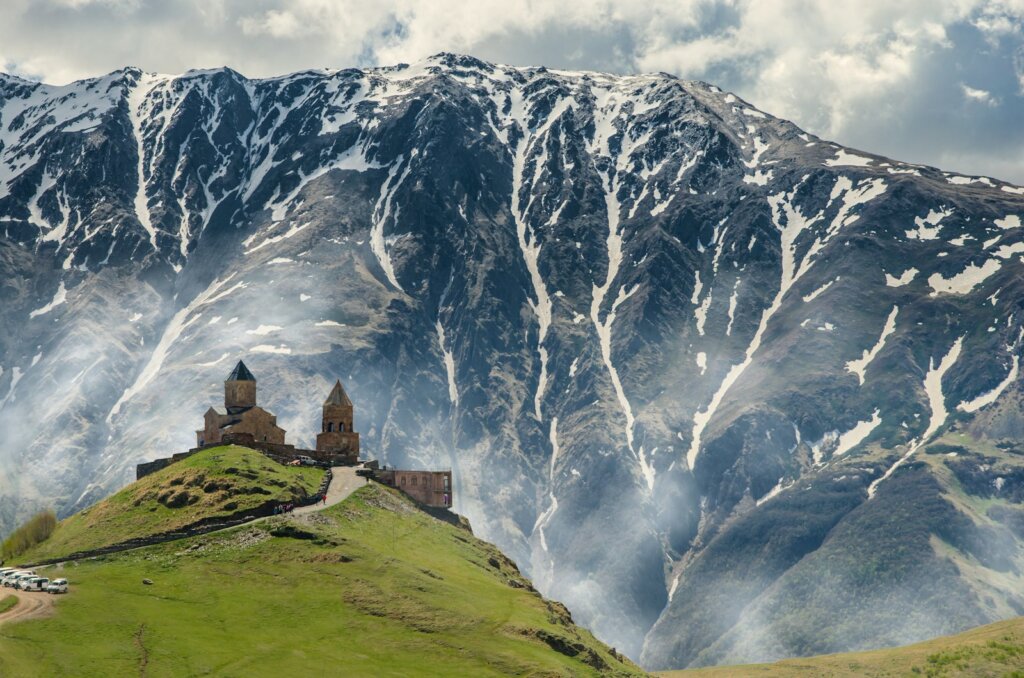
Where should I go on holiday in 2026?
The best places to travel in 2026 for UK travellers, ordered by search demand and booking momentum, are: Vietnam, Morocco, South Africa, China, Canada, Finland, the United Kingdom, Kazakhstan, Estonia and Senegal & Georgia. Vietnam leads on value and experiential depth, with Booking.com naming it the world’s number-one trending destination for 2026. Morocco offers the Sahara, Atlas Mountains and Marrakech within a four-hour flight of London. South Africa delivers Big Five safari, the Franschhoek wine route and the Garden Route self-drive at a pound-to-rand rate that makes world-class experiences accessible. China has opened visa-free access for UK passport holders for 30 days from February 2026. Canada offers the Icefields Parkway, the Great Bear Rainforest and free national park admission from June to September. Finland was named Lonely Planet’s Best in Travel 2026 country. Kazakhstan, Estonia, Georgia and Senegal represent the strongest low-competition, high-return opportunities of the year.
Is China safe to travel in 2026?
Yes, China is safe to travel in 2026 for UK tourists. The FCDO does not advise against travel to mainland China. The country opened 30-day visa-free access for UK passport holders on 17 February 2026, valid until 31 December 2026. The practical considerations for visitors are digital rather than safety-related: China’s Great Firewall blocks Google, WhatsApp, Instagram and YouTube, so a reliable VPN should be installed before departure. Payment apps Alipay and WeChat Pay now accept foreign Visa and Mastercard directly and can be configured before travel. Chinese carriers including Air China and China Eastern still overfly Russia, meaning London to Shanghai takes around 11 hours — faster and often cheaper than comparable long-haul routes affected by the airspace closure.
What is the best value long-haul destination in 2026?
Vietnam and South Africa represent the strongest value propositions for UK long-haul travellers in 2026. The pound currently buys approximately 35,500 Vietnamese dong, meaning boutique hotels in Hội An cost £30–60 per night and the overall gap between expenditure and experience is wider than almost any comparable destination. South Africa offers a pound-to-rand rate of approximately 22:1, which positions private game lodge stays at Sabi Sands at a price equivalent to a four-star London hotel. Kazakhstan is the strongest emerging value destination, with the pound buying around 630 tenge and world-class ski terrain at Shymbulak, golf and the Charyn Canyon accessible at Central Asian price points. Georgia, at 3.7 lari to the pound with direct flights from London under £150 return, offers Caucasian mountain scenery, 8,000 years of wine culture and 365 days visa-free for UK passport holders.
Do I need a visa to visit China from the UK in 2026?
No. From 17 February 2026, UK ordinary passport holders can enter mainland China visa-free for up to 30 days per visit, with unlimited multiple entries permitted. The policy covers tourism, business, family and friend visits, and transit, and runs until 31 December 2026. Travellers should carry a passport valid for at least six months beyond their intended stay and expect biometric fingerprinting on arrival. Most hotels handle the required local police registration automatically. The practical barriers to visiting China in 2026 — payment apps and VPN setup — can both be resolved before departure.
What is the best time to see the Northern Lights in Finland?
The best months to see the Northern Lights in Finland are September to October and February to March, when darkness is sufficient and clear skies are most frequent. The aurora is visible from late August through early April in Lapland. 2026 is a particularly strong year for aurora activity — Solar Cycle 25 is at or just past its maximum, producing elevated geomagnetic conditions that extend the season and intensify displays. Rovaniemi is the primary base, with direct winter charter flights from multiple UK airports including Gatwick, Luton, Manchester, Bristol and Edinburgh. Kakslauttanen Arctic Resort at Saariselkä offers glass igloos with thermal ceilings designed for aurora viewing and a Northern Lights alarm service for guests.
Is Kazakhstan worth visiting?
Yes. Kazakhstan is one of the most rewarding and undervisited destinations in the world for the traveller willing to engage with its scale. The Charyn Canyon is a miniature Grand Canyon of red sandstone formations 200 kilometres east of Almaty. The Kolsai Lakes are three glacial alpine lakes in the Tian Shan mountains at altitudes from 1,818 to 2,850 metres. The Kazakh Altai in the far east — a UNESCO Biosphere Reserve of 643,000 hectares bordering Russia and China — is one of the last genuinely wild landscapes in the northern hemisphere. Almaty itself offers sophisticated food, wine, padel, golf and world-class skiing at Shymbulak 40 minutes from the centre. UK passport holders are visa-free for 30 days. Air Astana operates a direct Heathrow to Almaty service of approximately 8 hours 10 minutes. Nomadical Tracks has travelled Kazakhstan extensively — read the full guide at nomadicaltracks.com.
What are the best emerging travel destinations in 2026?
The strongest emerging travel destinations for UK travellers in 2026 are Kazakhstan, Estonia, Senegal and Georgia. Kazakhstan offers frontier wilderness — the Charyn Canyon, Kolsai Lakes and Kazakh Altai — alongside a sophisticated Almaty base with skiing, golf and padel, visa-free for 30 days with one direct flight from London. Estonia provides Tallinn’s medieval old town, Lahemaa National Park and the most course-dense disc golf network on earth per square kilometre, within a 2 hour 45 minute flight for under £120 return. Senegal is hosting the Youth Olympic Games from 31 October to 13 November 2026 — the first IOC event ever held in Africa — making this the year to visit before international visibility increases. Georgia offers 8,000 years of wine culture, the Greater Caucasus mountains, ski terrain at Gudauri and the medieval tower villages of Svaneti, with direct flights from London under £150 and 365 days visa-free for UK passport holders.
Where is the best place to go on safari in 2026?
South Africa offers the strongest safari proposition for UK travellers in 2026. The private concessions on the western border of Kruger — Sabi Sands, Timbavati and Klaserie — provide unfenced access to the same ecosystem with off-road vehicles and guides whose knowledge of individual animals is biographical rather than observational. Sabi Sands, home to Singita, Londolozi and Mala Mala, has the highest density of leopard sightings on the African continent. The pound-to-rand rate of approximately 22:1 means a luxury lodge experience costs the equivalent of a four-star London hotel. South Africa has now passed 328 consecutive days without load-shedding. Cape Town is 11 hours 45 minutes direct from Heathrow. UK passport holders require no visa for stays of up to 90 days.
What are the best golf travel destinations in 2026?
The strongest golf travel destinations for UK players in 2026 are Morocco, Vietnam, South Africa, Kazakhstan and Georgia. Morocco offers courses around Marrakech — including Royal Golf Dar Es Salam, Amelkis and Samanah — with High Atlas views and reliable winter sunshine within a four-hour flight of London. Vietnam’s Da Nang corridor hosts Montgomerie Links, BRG Da Nang Golf Resort and the Greg Norman-designed Danang Golf Club, with Hoiana Shores by Robert Trent Jones Jr. nearby. South Africa’s Leopard Creek, adjacent to Kruger with animals visible from the fairways, and Fancourt in George — a five-course resort and former President’s Cup host — deliver world-class golf at pound-to-rand prices European equivalents cannot approach. Kazakhstan’s Nurtau Golf Club plays against the Zailiysky Alatau mountain range at Central Asian green fees. Georgia’s developing golf offer around Gudauri sits alongside its ski infrastructure at Caucasian price points.
Where is the best place to travel in 2026 for food and gastronomy?
Vietnam, Georgia, Morocco and South Africa are the strongest gastronomic travel destinations for 2026. Vietnam’s regional food variation is among the most pronounced in the world — what you eat in Hà Nội bears almost no resemblance to what you eat in Hội An or Hồ Chí Minh City, making the north-to-south journey a gastronomic itinerary in its own right. Georgia’s cuisine — khinkali dumplings, khachapuri bread, shkmeruli garlic chicken — is underpinned by 8,000 years of winemaking in clay qvevri vessels, with Kakheti producing amber wines from ancient grape varieties that have no equivalent elsewhere. Morocco’s Atlas Mountain cooking tradition — slow-cooked tagines, argan oil, preserved lemon — is one of the great underappreciated cuisines of the Mediterranean world, eaten best in small local restaurants beside rivers in the High Atlas. South Africa’s Franschhoek has built its identity entirely around the table, with Chenin Blanc and Bordeaux-style blends benchmarking against global competition at South African prices.


